
Automatic Marshall Compactor: 7 Checks That Could Save Your Lab Costly Rework
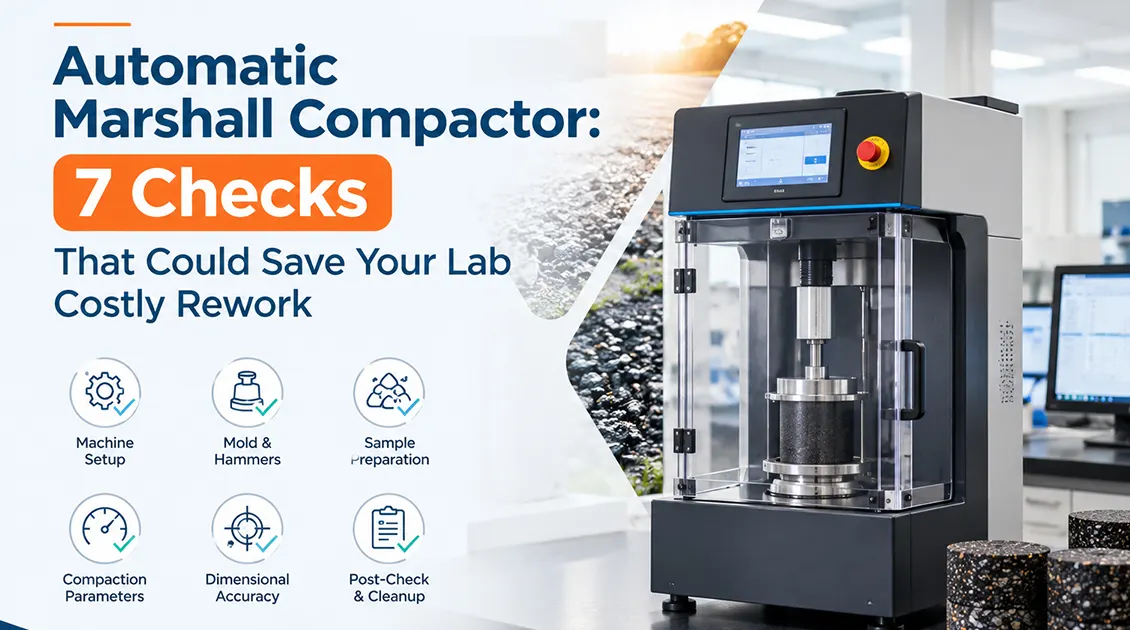
An asphalt specimen reaches the testing stage, but its results differ unexpectedly from the rest of the batch. The mixture proportions appear correct, the calculations check out, and the testing machine is working.
Could the difference have started during specimen preparation?
For asphalt laboratories, compaction is a critical part of producing specimens that can be compared meaningfully. Changes in preparation, temperature, equipment configuration, or compactive effort can complicate the interpretation of later results.
An Automatic Marshall Compactor mechanically applies a preset number of hammer blows to asphalt mixture inside a mould. It reduces repetitive manual lifting and counting while helping laboratories follow a defined compaction procedure.
However, automatic operation does not remove the need for careful preparation and equipment checks.
This Avantech guide explains how the machine works, what it contributes to asphalt testing, and seven considerations to review before purchasing.
What Is an Automatic Marshall Compactor?
An Automatic Marshall Compactor is a laboratory machine used to prepare compacted asphalt specimens through repeated mechanical impacts.
The operator places the prepared mixture in a compatible mould, secures the assembly, and selects the required blow count. The machine lifts and releases its hammer through the specified mechanism, then stops when the programmed cycle is complete.
Manufacturers offer different configurations, including stationary moulds, rotating moulds, and machines with multiple compaction stations. The appropriate arrangement depends on the laboratory’s method and workload.
The compactor prepares the specimen. Separate equipment and procedures are needed to measure properties such as Marshall stability and flow.
Why Does Marshall Specimen Preparation Matter?
A laboratory result represents both the material and the conditions under which it was prepared and tested.
If specimen preparation varies, it becomes harder to establish why results differ. The cause might involve the mixture, preparation temperature, equipment, or handling.
ASTM’s Marshall specimen preparation practice identifies several apparatus arrangements. It also recognises that different arrangements can produce different specimen densities even when the nominal hammer mass, drop height, and blow count are comparable.
This is why laboratories should document the compactor configuration and preparation procedure rather than recording only the number of blows.
Automation supports consistency within a controlled process. It cannot make different procedures equivalent.
How Does an Automatic Marshall Compactor Work?
1. Prepare the Mixture and Mould
Prepare the asphalt mixture according to the selected method.
Check that the mould, base plate, collar, hammer, and other accessories are clean, suitable, and ready for use. Follow the specified conditioning and temperature requirements.
2. Fill and Position the Mould
Introduce the required mixture quantity and complete the prescribed initial arrangement.
Secure the mould in the holder. Confirm that the hammer and mould assembly are correctly aligned before starting.
3. Select the Compaction Programme
Enter the required number of blows for the relevant face and procedure.
Do not choose a blow count simply because it is the machine’s previous setting.
4. Run the Cycle
Start the compactor and observe operation as required by the manufacturer’s instructions.
Automatic counters and shutoff functions are common features, but the exact operating sequence varies between machines.
5. Complete the Specimen Procedure
Where the method requires compaction on the opposite face, reposition the assembly and repeat the specified process.
Complete cooling, extraction, identification, and subsequent conditioning according to the procedure.
What Is the Compactor Used For?
Asphalt Mixture Design
Marshall-compacted specimens can form part of a mixture design programme.
Their preparation must be coordinated with the required measurements and acceptance framework.
Laboratory Quality Control
A documented compaction process helps laboratories prepare comparable specimens across batches, operators, and testing dates.
When unusual results appear, preparation records provide evidence for troubleshooting.
Plant-Produced Mixture Evaluation
Laboratories may prepare specimens from plant-produced mixtures where the selected method and project requirements permit.
Sampling, transport, conditioning, and preparation should remain traceable.
Preparation for Subsequent Tests
Compacted specimens may be used for physical testing and density or voids assessment, depending on the applicable procedure.
Marshall stability and flow testing is a separate operation addressed by ASTM D6927. A compactor alone does not perform that measurement.
7 Checks Before Buying an Automatic Marshall Compactor
1. Confirm the Applicable Method
Start with the project specification and laboratory procedure.
Identify the required apparatus arrangement, specimen dimensions, hammer characteristics, support conditions, and compaction programme.
Ask the supplier to confirm the proposed model against these requirements. A broad statement such as “Marshall compatible” leaves important details unresolved.
Also check the applicable standard edition rather than relying solely on an older reference in a catalogue.
2. Match Mould Size and Accessories
Confirm whether the laboratory needs equipment for nominal four-inch specimens, six-inch specimens, or both.
Do not assume that changing the mould is sufficient to convert a machine. Some systems require a different hammer assembly or other accessories.
Manufacturer documentation shows that conversion arrangements and included components differ between models. Obtain an itemised configuration for every size you intend to use.
3. Check the Hammer and Mould Arrangement
Stationary and rotating mould systems are distinct configurations.
Humboldt, for example, describes stationary mould models with flat-foot hammers and rotating mould models with tapered-foot arrangements.
Select the configuration required by the method. Avoid treating a different mechanism as an interchangeable replacement without a documented assessment.
For an existing laboratory, record the current apparatus before comparing a replacement proposal.
4. Review Blow Counting and Cycle Control
Ask how the machine counts blows, stops the cycle, and handles interruptions.
Check whether the display shows the selected and completed counts clearly. Clarify what operators should do after a stoppage or power interruption.
A demonstration should cover the complete sequence, including reset and restart procedures.
Reliable counting is useful only when the machine is also delivering the intended mechanical action.
5. Examine the Pedestal and Installation Requirements
The support arrangement forms part of the installation.
Review the required pedestal, anchoring, clearances, floor conditions, and electrical supply. Ask which installation components are included and which must be provided locally.
Do not select the machine based only on its footprint in a catalogue.
Arrange the workspace so operators can load, remove, and transport mould assemblies without unnecessary handling difficulties.
6. Evaluate Single or Multiple Stations
Compare station capacity with the laboratory’s actual workload.
A multi-station machine may help where several specimens need preparation together. Commercial triple-station compactors are available that compact three specimens simultaneously.
However, additional stations also require suitable preparation capacity, accessories, and operating space.
Estimate throughput across the whole workflow, including mixing, conditioning, extraction, and testing.
7. Confirm Maintenance, Training, and Support
Request instructions for routine checks, cleaning, lubrication where required, and replacement of worn components.
Clarify service arrangements and the availability of hammers, moulds, counters, and mechanical parts.
Include operator training in the proposal. Training should explain normal operation, equipment checks, and how to respond to unusual noise, movement, or interrupted cycles.
Manual vs Automatic Marshall Compaction
Consideration | Manual compaction | Automatic compaction |
Hammer lifting | Performed by the operator | Mechanically operated |
Blow counting | Operator-managed | Counter-managed where fitted |
Repetitive physical work | Greater | Reduced |
Cycle stopping | Operator-controlled | Preset shutoff where fitted |
Mixture preparation | Requires trained personnel | Requires trained personnel |
Procedure verification | Essential | Essential |
The strongest reason to automate is a defined operational need: repetitive workload, counting consistency, or specimen preparation capacity.
Common Mistakes That Can Undermine Results
Using One Blow Count for Every Programme
The required compactive effort comes from the governing procedure and specification.
Verify the setting for each programme rather than adopting a universal default.
Losing Control of Preparation Timing
Plan the sequence from mixture conditioning to compaction.
Record relevant temperatures and timing so variations can be investigated.
Ignoring Worn or Dirty Components
Inspect contact surfaces, mould assemblies, and mechanical components according to the maintenance instructions.
Cleaning and replacement decisions should be part of routine laboratory practice.
Confusing Compaction with Testing
A completed compaction cycle does not establish density, air voids, stability, or flow.
These require their own measurements and calculations.
Recording Too Little Information
Link each specimen to its mixture identification, preparation conditions, compactor configuration, blow count, operator, and relevant observations.
These records help explain differences between specimens.
Discussing Your Requirements with Avantech
A useful Automatic Marshall Compactor enquiry should describe the work your laboratory performs.
Provide Avantech with the governing methods, required specimen sizes, preferred configuration, expected daily workload, and available installation space.
Avantech’s Marshall equipment listings include an automatic double compactor with a rotating base. Confirm current availability, specifications, and included accessories before selecting a package.
Request an itemised proposal covering the machine, moulds, hammer assemblies, pedestal, electrical requirements, installation, training, and support.
Frequently Asked Questions
What does an Automatic Marshall Compactor do?
It prepares asphalt specimens by mechanically applying a selected number of hammer blows through a compatible compaction arrangement.
Does it measure Marshall stability and flow?
No. Specimen compaction and stability-flow testing are separate operations.
Can one machine prepare different specimen sizes?
Some models can, with suitable components. Confirm the required moulds, hammers, and conversion arrangements.
Is automatic compaction always more accurate?
Automation can improve execution consistency, but result quality still depends on preparation, equipment condition, installation, and procedure.
Is the same blow count suitable for every mixture?
No. Follow the applicable specification and method, including any laboratory requirements for the selected apparatus.
Choose Equipment Around a Controlled Preparation Process
An Automatic Marshall Compactor can reduce repetitive work and support consistent specimen preparation when it fits the laboratory’s method and workload.
Define the configuration, verify the installation, and keep the preparation records needed to explain your results.