
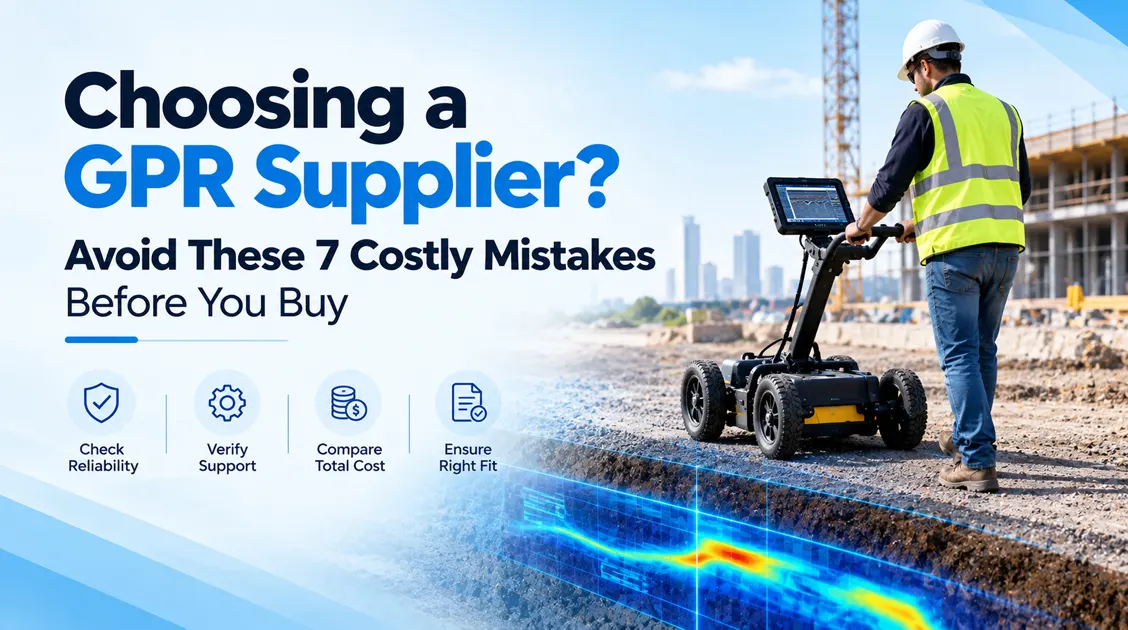
Choosing a GPR Supplier? Avoid These 7 Costly Mistakes Before You Buy
Buying ground penetrating radar equipment can feel straightforward. Compare a few specifications, check the quoted detection depth, and choose a system within budget.
The real challenge begins when that equipment reaches your site.
Will it detect the targets you need to investigate? Can your team interpret the results confidently? Does the quotation include the software required to produce your client’s report?
Choosing a GPR supplier means answering these questions before committing to a purchase.
What Is a GPR Supplier?
A GPR supplier provides ground penetrating radar equipment and associated products or services. Depending on the supplier and agreement, these may include antennas, controllers, software, accessories, demonstrations, operator training, and technical support.
The scope varies, so buyers should confirm exactly what is included.
A useful supplier discussion starts with your application: what you need to investigate, where the equipment will operate, and what information your team must deliver.
For example, locating buried utilities across an outdoor site creates different requirements from scanning a concrete slab before drilling. The equipment recommendation should reflect that difference.
How Does Ground Penetrating Radar Work?
Ground penetrating radar transmits electromagnetic energy into the ground or another material and records returning reflections. Reflections occur where there is sufficient contrast in electromagnetic properties.
The recorded signals help operators investigate subsurface features. However, the display requires interpretation; it does not automatically provide a definitive identification of everything below the surface.
Depth estimates also depend on the assumed or measured speed of radar waves through the material. An incorrect velocity assumption can affect the estimated depth.
The US Environmental Protection Agency describes GPR as a method used to investigate subsurface structure and locate features of interest through reflected radar signals.
Where Is GPR Commonly Used?
GPR supports several types of investigation, with equipment configurations selected for the task.
Underground Utility Investigations
GPR can contribute to locating buried infrastructure, including some metallic and non-metallic utilities. Its usefulness depends on conditions and the contrast between the target and surrounding material.
The Federal Highway Administration identifies GPR among the methods used in underground utility investigations.
Concrete Assessment
Suitable systems can help investigate reinforcement, embedded features, and concrete thickness. Access, reinforcement density, target depth, and the required detail influence equipment selection.
Geological and Environmental Surveys
GPR may also support investigations of subsurface layering, bedrock, and other geological features where conditions allow useful signal penetration. Manufacturers offer different antenna configurations for different investigation objectives.
Mistake 1: Choosing Equipment Before Defining the Application
A long specification sheet cannot compensate for an unclear requirement.
Before approaching a GPR supplier, describe the targets you expect to investigate. Include their likely size, material, depth, and surroundings.
Also explain how your team will work. Will operators survey open ground, navigate congested areas, or scan small sections of a structure? Will the results support immediate site marking or a detailed office-based report?
A short written brief helps suppliers recommend a configuration for your actual workload.
It also makes competing quotations easier to compare because every supplier is responding to the same requirements.
Mistake 2: Treating Maximum Detection Depth as a Guarantee
A quoted maximum depth deserves careful questioning.
GPR detection depth is site dependent. Conductive ground can weaken radar signals substantially. Ground composition, moisture-related conditions, antenna selection, and target characteristics influence what the equipment can resolve.
Clay-rich or saline environments can be particularly challenging because electrical conductivity contributes to signal attenuation.
Ask the supplier what conditions support the advertised depth. Then explain how your site differs.
A more useful purchasing question is: “Can this configuration resolve our expected targets under representative conditions?”
Request a demonstration where practical. Record both successful detections and areas where the results remain uncertain. Those limitations are part of understanding the equipment.
Mistake 3: Assuming One Antenna Suits Every Job
Antenna selection involves a balance between penetration and resolution.
Generally, lower frequencies support deeper investigation with less detail, while higher frequencies provide finer resolution over shallower investigation ranges.
GSSI’s utility-locating guidance explains this relationship between antenna frequency, penetration, and detectable target size.
That makes “Which antenna is best?” an incomplete question.
Instead, explain the smallest target you need to resolve and its expected depth. Ask how the proposed antenna addresses those requirements.
If your workload includes substantially different applications, discuss whether separate configurations are necessary. Confirm compatibility, additional costs, and the practical steps required to change between them.
Mistake 4: Buying Without a Meaningful Demonstration
An impressive demonstration should help you assess the complete workflow.
Watching an experienced operator locate a known target on a familiar demonstration site provides limited evidence about how your team will perform elsewhere.
Request a demonstration that resembles your intended work. Where possible, let your operators handle the equipment and review the resulting data.
Agree on the questions beforehand:
- What targets should the system investigate?
- What information is already known?
- How will uncertain findings be explained?
- Can the data be saved and reviewed later?
- What deliverables can be produced?
Keep a record of the configuration used. A demonstration involving different antennas or software may not represent the package you are buying.
Mistake 5: Underestimating Training and Interpretation
Operating the controls and interpreting radar data are different skills.
Your team needs to understand survey planning, data collection, instrument settings, and the limitations of its conclusions.
For instance, a recurring feature on a radar profile may warrant further investigation, but interpretation requires context. Operators must know when the evidence is insufficient for a confident statement.
Ask whether training includes practical exercises, review of collected data, and discussion of difficult conditions.
Manufacturer training programmes demonstrate that instruction can be supplied alongside equipment or arranged separately. However, buyers must confirm their own package and scope.
Plan time for supervised practice after initial training, particularly when introducing GPR to an inexperienced team.
Mistake 6: Comparing Prices Without Comparing Complete Packages
Two quotations may appear similar while covering very different purchases.
One may include the controller and processing software. Another may require separate purchases before your team can complete its reporting workflow.
Compare the full package:
Purchase element | What to confirm |
Hardware | Exact system, antennas, controller, and accessories |
Software | Included functions, licence terms, and renewal costs |
Training | Duration, content, location, and participant allowance |
Warranty | Coverage, exclusions, and repair arrangements |
Support | Contact process, availability, and escalation route |
Delivery | Lead time, shipping costs, and acceptance process |
Also check batteries, chargers, protective cases, compatible positioning equipment, and replacement parts.
A clear quotation reduces unexpected costs and helps your team prepare for deployment.
Mistake 7: Overlooking Support After Delivery
Equipment ownership continues long after installation.
Consider what happens if the controller stops working before a scheduled survey, an accessory becomes damaged, or a software update changes the workflow.
Ask who provides assistance and how repairs are arranged. Confirm whether support comes directly from the manufacturer, the supplier, or another service provider.
Where a supplier claims authorised status, request evidence relevant to the proposed brand and territory.
Keep important commitments in writing. A verbal assurance about support is harder to evaluate than a documented process with named responsibilities.
The aim is to understand how your team will keep working when a problem occurs.
How to Compare GPR Suppliers Fairly
Use a consistent evaluation process.
Send each supplier the same application brief and request the same package details. Review technical suitability separately from price so that a cheaper quotation does not hide an unsuitable configuration.
Assess the demonstration, training scope, software workflow, and support arrangements against your operational requirements.
Include the people who will use the equipment. Their feedback on handling, screen readability, transport, and reporting can reveal practical issues that a purchasing spreadsheet misses.
Before ordering, confirm the final configuration and acceptance criteria. This creates a shared understanding of what must arrive and how the purchase will be checked.
Preparing Your Enquiry for Avantech
For a focused discussion with Avantech, prepare a brief covering your application, expected targets, site conditions, preferred deliverables, budget range, and purchase timeline.
Mention whether your organisation already has trained operators and compatible software.
If you have representative site photographs, previous survey information, or a sample report format, include them with the enquiry.
Request written confirmation of the recommended configuration, available training, warranty terms, and support scope. This gives your team a concrete proposal to assess before making a purchasing decision.
Frequently Asked Questions
What does GPR stand for?
GPR stands for Ground Penetrating Radar, a geophysical technique that uses electromagnetic signals to investigate features beneath a surface.
Can GPR detect plastic pipes?
It can detect some plastic pipes where the pipe, its contents, or associated ground disturbance creates a detectable contrast. Detection depends on the site and target conditions; it is not guaranteed.
Can GPR identify every buried utility?
No. GPR findings have limitations. Utility investigations may require records, complementary locating methods, and appropriate verification before excavation. An absence of a clear radar response does not establish that an area contains no utilities.
How much does GPR equipment cost?
Pricing depends on the model, antenna configuration, software, accessories, training, and support package. Request an itemised quotation based on your application rather than relying on a generic price.
What matters most when choosing a GPR supplier?
Prioritise application suitability, a representative demonstration, clear commercial terms, operator training, and dependable support. These factors help determine whether the equipment will serve your team’s actual workload.