
Concrete NDT Testing Equipment: 7 Costly Mistakes You Can’t Afford to Make
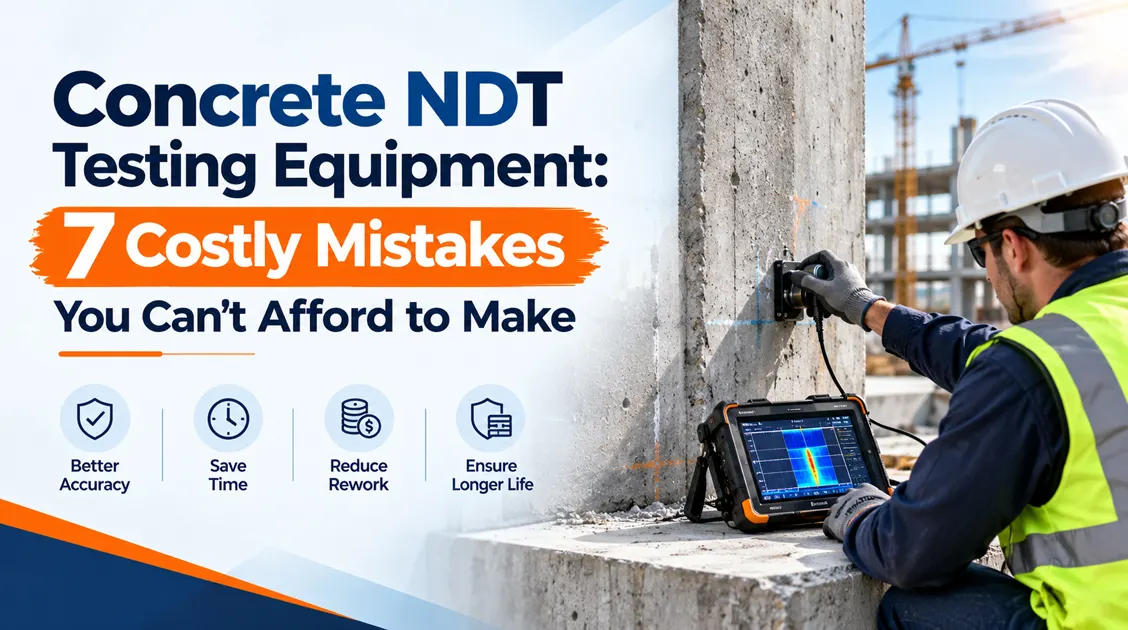
Concrete can look perfectly sound while leaving important questions unanswered. Is its quality consistent? Where is the reinforcement? Could deterioration be developing beneath the surface?
For engineers, contractors, and asset owners, these questions affect inspection planning, repair budgets, and everyday project decisions.
Concrete NDT testing equipment helps investigate concrete conditions without extensive cutting, breaking, or sample removal. Depending on the method, it can provide information about surface hardness, internal uniformity, reinforcement position, or corrosion likelihood.
However, useful results depend on more than owning a sophisticated instrument. Selecting the appropriate method, collecting reliable measurements, and understanding their limitations matter just as much.
This Avantech guide explains the main equipment categories, their applications, and seven common mistakes to avoid when planning concrete inspections.
What Is Concrete NDT Testing Equipment?
Concrete NDT testing equipment consists of instruments used for the nondestructive testing of concrete structures. These tools measure physical responses that help specialists investigate particular aspects of concrete and embedded reinforcement.
Common examples include rebound hammers, ultrasonic pulse velocity testers, reinforcement cover meters, ground penetrating radar systems, and corrosion assessment instruments.
Each answers a different question. A rebound hammer measures surface rebound response. An ultrasonic instrument measures pulse travel time. A reinforcement scanner helps locate embedded steel.
There is no universal instrument that directly measures every aspect of structural condition. Start by identifying what you need to investigate, then select equipment suited to that objective.
Why Is Concrete NDT Testing Useful?
An inspection often begins with uncertainty. Drawings may be incomplete, visible damage may be limited, or repair work may require information about inaccessible areas.
NDT can help teams investigate these uncertainties while limiting disturbance to the structure.
For example, a refurbishment project may need reinforcement mapping before proposed openings are assessed. A condition survey may require measurements across multiple locations to identify areas needing closer investigation.
The practical value lies in developing an evidence base for the next decision. Testing should have a clear purpose: identifying variation, planning further investigation, monitoring condition, or supporting an engineering assessment.
Collecting large quantities of data without that purpose can leave a project with impressive reports and few useful answers.
Main Types of Concrete NDT Testing Equipment
1. Concrete Rebound Hammer
A rebound hammer uses a spring-driven impact mechanism to measure the rebound response of a concrete surface.
It is commonly used to compare surface hardness and investigate relative uniformity. However, rebound readings are affected by surface moisture, finishing, carbonation, and other conditions.
Estimating compressive strength requires an appropriate relationship between rebound number and strength for the concrete being assessed. A generic conversion chart should not be treated as definitive proof of strength. ASTM also cautions against using this method alone as the basis for concrete acceptance or rejection.
2. Ultrasonic Pulse Velocity Tester
An ultrasonic pulse velocity, or UPV, tester measures how long an ultrasonic pulse takes to travel along a known path through concrete.
UPV testing can help assess relative quality and uniformity, indicate possible cracks or voids, and evaluate crack repair effectiveness.
The measurement represents wave propagation through the material. It should not automatically be presented as a direct compressive strength result. Test arrangement and interpretation must suit the investigation.
3. Rebar Locator and Cover Meter
Electromagnetic reinforcement locating equipment helps identify embedded steel and assess concrete cover depth.
This can be useful when checking reinforcement layouts or investigating structures with incomplete records. Depending on the instrument and conditions, additional information about bar orientation or size may be available.
Define the required depth range and reinforcement arrangement before selecting equipment. A simple isolated-bar demonstration may not represent the conditions on a congested structural member.
- Ground Penetrating Radar
Ground penetrating radar, or GPR, uses electromagnetic signals to investigate features beneath the concrete surface.
Concrete applications include mapping reinforcement, identifying certain embedded objects, and investigating interfaces or anomalies. Results depend on the material, survey configuration, and interpretation.
For a proposed drilling location, use the survey as part of a documented clearance procedure. Confirm the investigation scope and unresolved uncertainties before work proceeds.
5. Corrosion Assessment Instruments
Half-cell potential equipment helps assess the likelihood of corrosion activity in embedded reinforcement. It does not directly measure corrosion rate or the remaining steel cross-section.
Electrical resistivity testing provides complementary information about the concrete environment associated with corrosion susceptibility.
These methods answer related but different questions. Their findings need to be considered alongside site observations and other investigation results.
- Impact-Echo Equipment
Impact-echo testing uses the concrete’s response to a mechanical impact to investigate characteristics such as plate thickness or potential internal discontinuities.
Its usefulness depends on the investigation objective and structural configuration. FHWA research includes impact echo among the methods evaluated for concrete bridge deck assessment.
For complex investigations, selecting complementary technologies can provide more useful coverage than expecting one method to resolve every concern.
7 Costly Mistakes to Avoid
Mistake 1: Buying Equipment Before Defining the Problem
A project team may request “a concrete tester” without specifying what the instrument must establish.
That leaves too much open to interpretation. Locating reinforcement, comparing surface hardness, and investigating internal discontinuities require different measurement approaches.
Write a short inspection brief first. Identify the structural element, suspected issue, available access, required output, and decision the results will support.
This gives equipment discussions a practical starting point.
Mistake 2: Treating an Indirect Reading as a Final Verdict
A clear digital display can make a measurement appear more conclusive than it is.
Ask what the instrument actually measures. Then distinguish that measurement from the engineering conclusion being drawn from it.
For example, a rebound number and a verified compressive strength are different outputs. Similarly, locating reinforcement does not establish its structural adequacy.
Reports should explain how conclusions were reached, including relevant correlations and limitations.
Mistake 3: Ignoring Verification and Calibration Requirements
Equipment needs a documented process for checking that it is functioning appropriately.
Before testing, review the manufacturer’s instructions, instrument identification, calibration documentation where applicable, and required reference checks.
Also confirm who is responsible for these checks and how they will be recorded.
A consistent procedure makes it easier to investigate unexpected results. Without records, teams may struggle to determine whether variation comes from the concrete, the instrument, or the testing process.
Mistake 4: Overlooking Access and Site Conditions
Equipment suitability should be assessed against the actual location.
Can the operator reach the surface safely? Is access available from one side or multiple sides? Are coatings, rough finishes, moisture, or congested reinforcement relevant to the proposed method?
Share photographs, dimensions, and access restrictions before arranging equipment.
This helps avoid arriving on site with an instrument that cannot collect the information the inspection requires.
Mistake 5: Testing Too Few Locations
A convenient measurement location may not represent the area under investigation.
Plan a survey pattern that reflects the structure, inspection objective, and suspected variation. Include a clear way to identify each test position.
If unusual readings appear, define how the investigation will expand or how those locations will be checked.
The aim is representative evidence. A few isolated results should not quietly become a conclusion about an entire structure.
Mistake 6: Forgetting Reporting and Data Management
Consider the final deliverable before testing begins.
Will the client need individual readings, mapped results, photographs, annotated drawings, or repeat comparisons? Can the selected instrument export information in a usable format?
Each result should remain linked to its location and relevant testing conditions.
Good data management helps reviewers understand the findings and allows future teams to repeat measurements meaningfully.
Mistake 7: Assuming Training Is Optional
Operating an instrument and interpreting its results are separate skills.
A useful demonstration should explain setup, measurement technique, common sources of error, and the boundaries of the method.
Ask operators how they would respond to inconsistent readings or an unexpected signal. Their answer should include investigation and judgment, rather than simply repeating measurements until an acceptable number appears.
Build training and interpretation responsibilities into the testing plan.
How to Choose Concrete NDT Testing Equipment
Use the investigation objective to narrow the equipment category:
Inspection objective | Equipment category to evaluate |
Compare concrete surface rebound response | Rebound hammer |
Assess ultrasonic travel characteristics | UPV tester |
Locate reinforcement and assess cover | Rebar locator or cover meter |
Map embedded features | Concrete GPR |
Investigate corrosion likelihood | Half-cell potential equipment |
Assess the concrete’s corrosion-related environment | Electrical resistivity meter |
Investigate plate thickness or discontinuities | Impact-echo equipment |
Then compare practical requirements: measurement range, access, operator capability, accessories, documentation, data export, maintenance, and service arrangements.
When discussing concrete NDT testing equipment with Avantech, provide the project brief and request confirmation of the proposed model’s suitability, included components, and available support.
Frequently Asked Questions
Can concrete NDT testing equipment measure compressive strength?
Some methods support strength estimation when appropriate correlations are established. An indirect instrument reading should not automatically be treated as verified compressive strength.
Which concrete NDT testing equipment is best?
The appropriate equipment depends on the question. Reinforcement mapping, uniformity assessment, and corrosion investigation require different methods.
Does NDT completely replace core testing?
No. NDT can help guide an investigation, but targeted sampling or other verification may still be required to answer specific engineering questions.
Can concrete testing be carried out from one side?
Some methods support one-sided access. Suitability depends on the instrument, structural geometry, material conditions, and information required.
What should I ask before purchasing?
Ask about application suitability, measurement limitations, verification requirements, training, accessories, reporting, and ongoing support. Request a demonstration relevant to your intended work.
Plan the Inspection Before Choosing the Instrument
Concrete NDT testing equipment is most useful when every measurement serves a defined purpose.
Begin with the question, select an appropriate method, and establish how the findings will be interpreted. That approach helps turn instrument readings into information a project team can use.