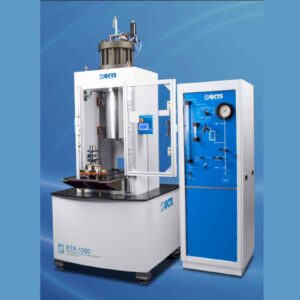
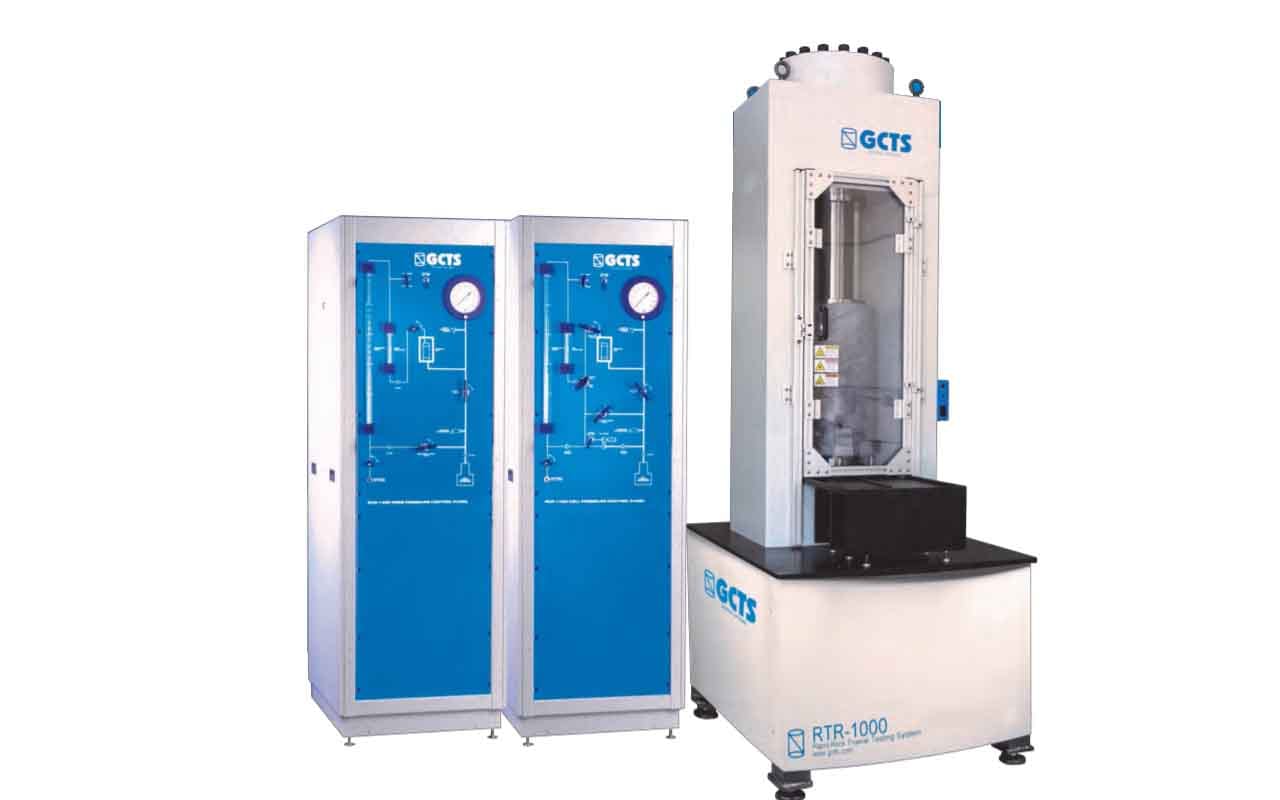
GCTS Triaxial Testing Systems were designed to quickly and easily perform triaxial tests on rock specimens. These systems can be configured with a wide range of load capacities, pressure capacities, temperature ratings, specimen sizes and frame stiffnesses to provide a unique system for each customer. Each system is equipped with our state-of-the-art servo-controller and software to automatically perform a complete triaxial test from start to finish, including multi-stage procedures.
The RTR Series of systems feature a box load frame with an integrated cell lift and locking mechanism. A single button raises and lowers the cell and locks it in place – no bolts are needed! This drastically reduces the preparation time between tests, easily doubling the number of tests that can be performed in a single day compared to standard testing systems. Each system can be upgraded to perform a variety of tests in addition to standard triaxial testing, including indirect tension, pulse-decay permeability, and even direct shear!
GCTS also offers the RTX Series of systems, which include a four-column load frame and stand-alone triaxial cell in addition to our servo-controller and automatic testing software.
Frequently Asked Questions
1. What is Rock Triaxial Testing Equipment?
Rock Triaxial Testing Equipment is a laboratory testing system used to evaluate the strength and deformation behaviour of rock specimens under controlled axial and confining pressures. It helps researchers understand how rocks respond to different stress conditions.
2. What is the GCTS RTR Series Rock Triaxial Testing System used for?
The GCTS RTR Series is used for triaxial and unconfined testing of rock specimens. It supports research into rock strength, deformation, stress-strain behaviour and post-failure response.
3. How does a Rock Triaxial Testing System work?
The system applies controlled axial loading to a rock specimen while confining pressure is maintained around it inside a triaxial cell. Sensors measure specimen response, allowing researchers to analyse mechanical behaviour under different stress conditions.
4. What is the maximum axial load capacity of the RTR Series?
The RTR Series offers configurable axial load capacities ranging from 1,000 kN to 4,500 kN, depending on the selected system configuration.
5. What is the maximum confining pressure of the RTR Series?
The integrated triaxial cell is available with confining pressure capacities of 70 MPa, 140 MPa or 210 MPa, depending on the selected configuration.
6. What additional tests can be performed using the RTR Series?
With suitable optional accessories, the RTR Series can support indirect tension, ultrasonic velocity measurement, rock fracture toughness, true triaxial testing, acoustic emission, direct shear, hydraulic fracturing and permeability testing.
7. Where can I find Rock Triaxial Testing Equipment in India?
Avantech Engineering Consortium offers GCTS Rock Triaxial Testing Systems for research and commercial laboratory applications. Contact the team to discuss load capacity, pressure requirements, specimen dimensions and optional testing configurations.