
Automatic Triaxial Testing System: Is Your Lab Losing Time Between Test Stages?
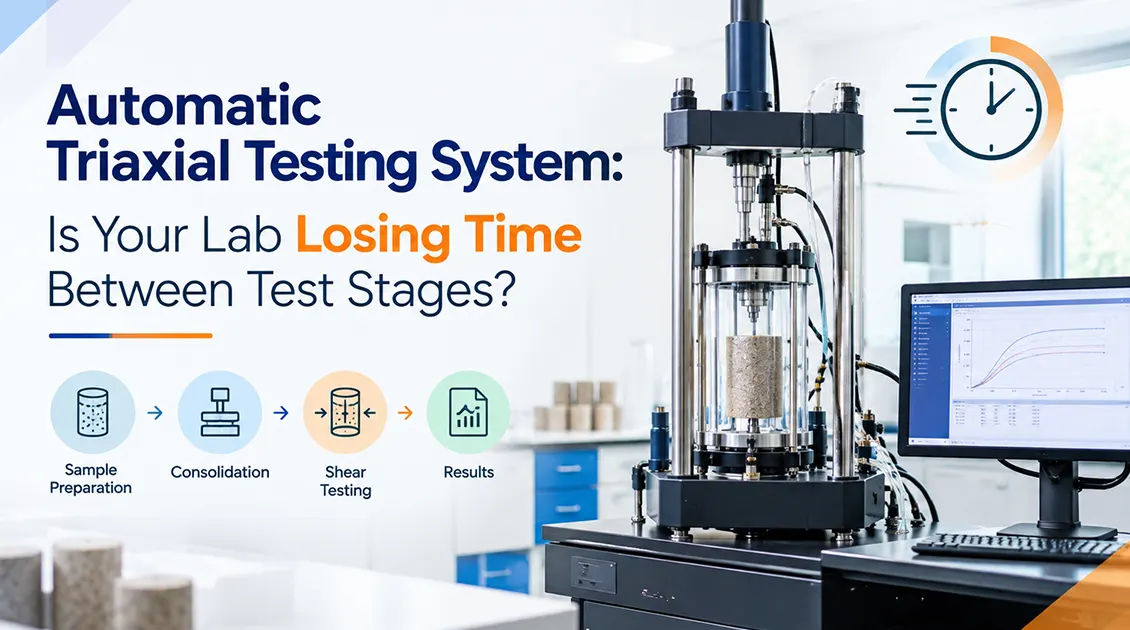
A soil specimen is ready for its next testing stage, but the laboratory technician is busy elsewhere. Pressure adjustments need attention, readings need recording, and another specimen is waiting for preparation.
For laboratories managing several investigations, these small interruptions can complicate an already demanding workflow.
An Automatic Triaxial Testing System helps manage specified test operations through integrated loading equipment, pressure controllers, sensors, and software. Depending on its configuration, it can control stages, collect measurements, and reduce repetitive intervention.
However, automation is not simply a shortcut to faster results. Soil still needs time to respond, and operators remain responsible for specimen preparation, suitable settings, and interpretation.
This Avantech guide explains how automated triaxial testing works, what benefits it can offer, and how to select equipment around your laboratory’s actual requirements.
What Is an Automatic Triaxial Testing System?
An Automatic Triaxial Testing System is an integrated laboratory setup used to investigate soil behaviour under controlled loading and confinement.
A cylindrical specimen is enclosed in a membrane inside a pressure cell. The system applies confining pressure and axial loading while recording the measurements required by the selected procedure.
Automation can include pressure adjustment, loading control, data acquisition, and programmed stage management.
Commercial systems offer different combinations of these functions. For example, automatic control software can manage saturation, consolidation, and shearing, subject to the installed hardware and software modules.
The word “automatic” therefore needs clarification: which operations are controlled, which transitions are automated, and where must an operator intervene?
What Does Triaxial Testing Measure?
Triaxial testing investigates how a specimen responds to specified stress and drainage conditions.
Depending on the method and instrumentation, recorded measurements can include:
- Axial load and deformation.
- Cell pressure.
- Pore-water pressure.
- Water volume change.
- Additional local strain measurements.
These measurements support calculations and interpretation of strength and stress–strain behaviour.
The required outputs should determine the equipment configuration. A laboratory needing routine total-stress results may have different requirements from a research team investigating effective stress paths.
Define the engineering question before selecting sensors, controllers, or software options.
Which Tests Can an Automated System Perform?
Test capability depends on the complete configuration and applicable method.
Unconsolidated Undrained Testing
In unconsolidated undrained, or UU, testing, the specimen is sheared without a prior consolidation stage and without drainage during shearing.
ASTM D2850 addresses this test category for cohesive soils.
Consolidated Undrained Testing
In consolidated undrained, or CU, testing, consolidation precedes shearing under undrained conditions.
Where pore pressure is measured using a suitable procedure, the results support effective-stress interpretation as well as total-stress assessment. ASTM D4767 covers CU testing for cohesive soils.
Consolidated Drained Testing
In consolidated drained, or CD, testing, drainage is allowed during consolidation and shearing.
The shearing rate must be slow enough to permit pore-pressure dissipation. Automation does not remove this requirement.
Advanced Testing
Stress-path or cyclic investigations require appropriate control functions, instrumentation, and software. Routine automation should not be assumed to include these capabilities.
How Does an Automated Triaxial Test Progress?
1. Specimen Preparation and Assembly
The operator prepares the specimen, measures its dimensions, and documents relevant conditions.
The specimen is installed with the appropriate membrane, drainage components, and instrumentation. Connections and measurement channels are checked before testing.
2. Saturation Where Required
For procedures requiring saturation, the system follows the selected pressure programme.
Completion should depend on the method’s criteria and suitable verification rather than an arbitrary timer.
3. Consolidation Where Required
The specimen is brought to the target stress conditions and allowed to consolidate.
Operators review the relevant measurements to confirm that the criteria for moving forward have been satisfied.
4. Shearing and Data Collection
The system applies the programmed loading conditions and records the required channels.
5. Review and Reporting
The laboratory checks data quality, calculations, observations, and procedural departures before issuing results.
Where Automation Can Improve Laboratory Work
More Consistent Execution
A saved procedure can help operators follow the same programmed sequence across comparable tests.
That consistency is useful when the settings have been reviewed and the procedure remains appropriate for each specimen.
Less Repetitive Adjustment
Automatic controllers can reduce repeated manual pressure or loading adjustments.
This can allow technicians to spend more attention on preparation, verification, and reviewing unusual behaviour.
Better Measurement Records
Integrated acquisition can retain time-linked measurements throughout a test.
The practical benefit is traceability: reviewers can examine what happened between the starting conditions and the final result.
Fewer Delays at Stage Changes
Some systems automate valve operations as well as controller settings.
Dedicated automatic valves are available specifically to manage transitions between saturation, consolidation, and undrained shearing. This illustrates why stage-transition capability should be checked separately from automatic data logging.
Manual vs Automatic Triaxial Testing
Consideration | Predominantly manual setup | Automatic setup |
Pressure adjustments | Greater operator involvement | Controller-managed where configured |
Data recording | Manual or separately logged | Integrated acquisition where supplied |
Stage transitions | Often operator-dependent | May be programmed with suitable hardware |
Procedure execution | Relies heavily on operator consistency | Follows configured sequences |
Specimen preparation | Requires trained personnel | Requires trained personnel |
Result interpretation | Requires technical review | Requires technical review |
Automation changes how operations are executed. It does not eliminate the need for a competent testing process.
7 Features to Check Before Selecting Equipment
1. Supported Methods and Outputs
List the tests your laboratory needs to perform.
Identify required measurements, specimen conditions, drainage arrangements, and reporting outputs. Request confirmation against the proposed configuration rather than accepting a general statement that the machine “does triaxial testing.”
2. Specimen Compatibility
Confirm specimen diameters, cell dimensions, loading accessories, membranes, and preparation equipment.
Consider whether future work will require different sizes. Ask which changes involve accessories and which require a different cell or frame.
3. Load Capacity and Control
Specify expected forces, deformation range, and loading rates.
Review measurement performance across the intended working range. Maximum capacity alone does not establish suitability for small loads or precise deformation control.
4. Pressure and Volume Performance
Compare operating range, control performance, measurement accuracy, and available controller volume.
Ask how the system handles controller capacity limits during longer procedures and whether any intervention is necessary.
5. Extent of Automation
Request a demonstration of the complete sequence.
Identify manual valve changes, operator approvals, refill requirements, and stage-completion decisions. A system that automatically records readings may still require substantial manual operation.
6. Software and Data Access
Check access to raw measurements, settings, stage histories, and calculation inputs.
Confirm export formats, software licensing, computer requirements, and backup arrangements. The laboratory should be able to review the evidence behind an automatically generated graph.
7. Training and Support
Include commissioning, operator training, calibration arrangements, replacement components, and service terms in the comparison.
Training should cover both normal operation and troubleshooting, including leaks, unexpected pore-pressure responses, and interrupted tests.
Common Mistakes When Introducing Automation
Assuming Every Specimen Can Use One Programme
Saved settings are convenient, but the material and investigation may require different conditions.
Review each programme before use and control changes to laboratory templates.
Moving Between Stages Too Soon
Avoid choosing short stage durations simply to increase throughput.
Automation can reduce waiting for an operator; it cannot justify bypassing the physical response or completion criteria required by the method.
Ignoring System Checks
Complete appropriate checks of sensors, drainage lines, connections, seals, and controller operation.
A programmed sequence can repeat an incorrect setup just as consistently as a correct one.
Accepting Calculations Without Review
Verify specimen dimensions, units, correction settings, and channel assignments.
Keep calculations linked to the original measurements so another reviewer can understand and check the reported values.
Discussing Your Requirements with Avantech
A useful enquiry for an Automatic Triaxial Testing System begins with a clear application brief.
Provide Avantech with your soil types, specimen sizes, required methods, expected testing volume, pressure requirements, and measurement needs.
State whether the programme requires routine static testing, stress-path control, or dynamic loading.
Avantech’s published STX-100 product information describes automated test stages and dynamic applications, demonstrating the importance of distinguishing advanced configurations from routine systems. Confirm current specifications and suitability directly against your requirements.
Request an itemised proposal covering equipment, software, accessories, installation, training, and support.
Frequently Asked Questions
Does an Automatic Triaxial Testing System prepare specimens?
Generally, specimen preparation and assembly remain operator tasks. Confirm the scope of any specialised preparation equipment separately.
Can one system perform UU, CU, and CD tests?
Many configurations support these methods, but the necessary pressure control, drainage arrangements, sensors, and software must be included.
Does automation make every test faster?
It can reduce manual intervention and transition delays. Necessary saturation, consolidation, and drainage time still depend on the specimen and procedure.
Is an automatic system also a true triaxial system?
No. Automation describes control functions. True triaxial apparatus allows independent control of three principal stresses, unlike conventional axisymmetric equipment.
What should buyers prioritise?
Prioritise method suitability, measurement performance, complete workflow, data access, training, and support before comparing headline prices.
Choose Automation Around the Work Your Lab Performs
An Automatic Triaxial Testing System is most useful when its capabilities match a clearly defined testing programme.
Specify the required outputs, examine the complete workflow, and confirm where operator judgment remains essential.