
GPR Testing Services: Discovering What Lies Beneath the Surface
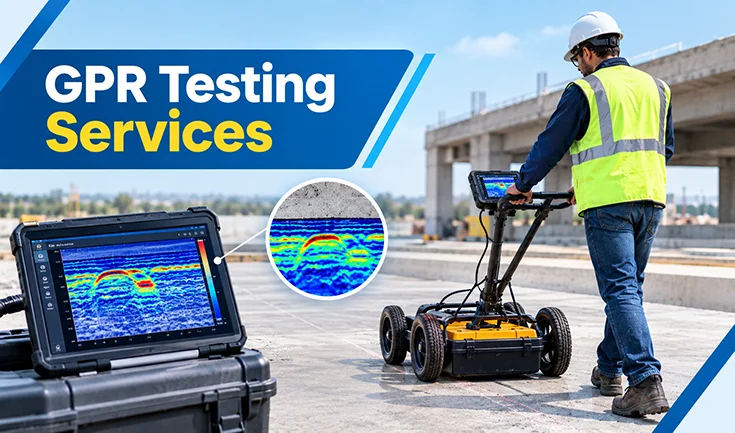
Construction and infrastructure projects frequently require information about features that cannot be seen from the surface.
Underground utilities, embedded reinforcement and changes in subsurface conditions can create challenges during excavation, drilling and structural investigation.
Professional Gpr Testing Services use ground penetrating radar technology to investigate hidden features and support better-informed engineering decisions.
What Is Ground Penetrating Radar?
Ground penetrating radar, commonly known as GPR, is a geophysical investigation method that uses electromagnetic signals.
A transmitting antenna sends signals into the material being investigated. Reflections occur when those signals encounter boundaries between materials with different electromagnetic properties.
The returned signals are recorded and interpreted to identify possible subsurface features.
Common Applications of GPR Testing
Concrete Scanning
GPR can help investigate reinforced concrete structures and identify embedded features before drilling or cutting.
Underground Utility Detection
Radar surveys may assist in locating buried pipes, cables and other subsurface features where ground conditions permit.
Pavement Investigation
GPR can support investigations involving pavement layers, thickness variations and possible subsurface anomalies.
Structural Assessment
Radar-based surveys may provide information about reinforcement arrangement and certain internal concrete conditions.
Engineers can combine these investigations with other Ndt Concrete Testing Services when a broader assessment is needed.
Factors Affecting GPR Results
The performance of GPR depends on several factors, including:
- Soil and material conductivity
- Moisture conditions
- Antenna frequency
- Target size and depth
- Survey accessibility
- Signal interference
Highly conductive materials may reduce signal penetration.
For this reason, GPR should not be treated as a method that guarantees detection of every buried object.
Choosing Suitable Equipment
Organisations planning regular surveys may consider working with a Gpr Supplier to explore equipment for different investigation requirements.
The selected radar system should match the material, required penetration depth and desired resolution.
Conclusion
Ground penetrating radar provides a valuable method for investigating hidden features in concrete, soil and pavement.
When used appropriately, it helps engineers reduce uncertainty and plan construction or maintenance activities more effectively.