
Large Size Triaxial: Is Your Lab Missing the Bigger Picture in Soil Testing?
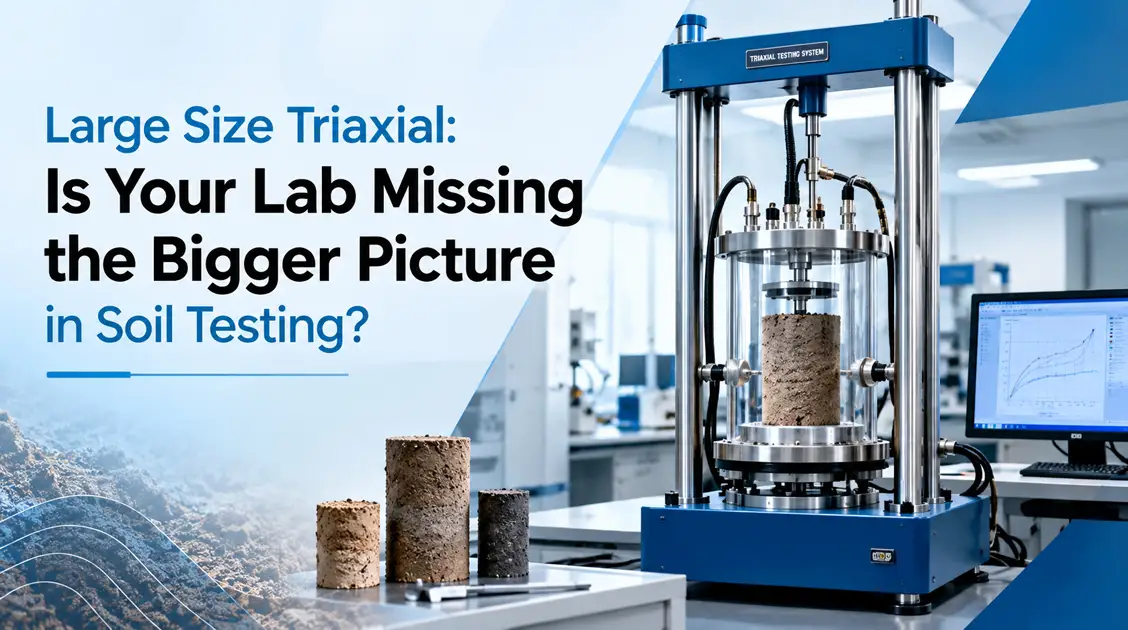
A laboratory result can look convincing on paper. The equipment runs smoothly, the graph appears consistent, and the report includes clear numbers. But one question deserves attention before those results support an engineering decision: does the specimen adequately represent the material being investigated?
This becomes particularly important with gravel, railway ballast, rockfill, and other coarse-grained materials. Their larger particles can create challenges for conventional specimen sizes.
Large Size Triaxial testing uses larger cylindrical specimens to investigate material behaviour under controlled confinement and axial loading. It helps laboratories study coarse materials where specimen size and particle size require careful consideration.
However, a larger apparatus alone does not guarantee better results. Sample preparation, drainage conditions, measurement quality, and the testing procedure remain essential.
This Avantech guide explains what Large Size Triaxial testing involves, where it can be useful, and what laboratories should consider before selecting a system.
What Is Large Size Triaxial Testing?
Large Size Triaxial testing is a laboratory testing approach that evaluates larger specimens under controlled stress conditions.
In a conventional axisymmetric triaxial compression arrangement, a cylindrical specimen sits inside a pressure cell. Confining pressure acts around it while the loading system applies axial compression.
The equipment records measurements appropriate to the test, such as axial load, deformation, pressure, and volume change.
“Large size” describes the specimen and apparatus scale; it does not identify one universal specimen diameter or equipment capacity. Commercial large-diameter systems can accommodate coarse materials such as railway ballast, with capabilities depending on their configuration.
Why Does Specimen Size Matter?
Imagine trying to understand a coarse granular material using a specimen that contains only a small number of its largest particles.
The specimen boundaries and individual particle arrangements may strongly influence the response. Removing oversized particles to fit a smaller cell also changes the material being tested.
A larger specimen can help accommodate a more representative particle-size distribution. However, laboratories still need to evaluate the relationship between specimen dimensions and maximum particle size.
ASTM-published research on large-scale triaxial testing highlights specimen-to-particle size relationships as an important consideration. The applicable method and material must guide the final specimen selection.
The practical question is straightforward: are you testing a suitable representation of the material, and have any preparation changes been documented?
How Does a Large Size Triaxial System Work?
Although procedures vary, a typical programme follows several stages.
1. Characterise and Prepare the Material
Begin by documenting particle-size distribution, moisture condition, target density, and specimen preparation method.
Where the material is reconstituted, the preparation procedure should be repeatable. Record any excluded particles or changes to the original grading.
2. Assemble the Specimen
Position the specimen between the appropriate end components and enclose it in a suitable membrane.
Connect drainage and measurement lines as required. Check alignment, seals, and instrumentation before proceeding.
3. Establish the Required Test Conditions
Depending on the method, this may include saturation, application of confining pressure, and consolidation.
The laboratory should define the criteria for completing each stage rather than relying only on elapsed time.
4. Apply Loading and Record Measurements
Load the specimen under the selected control conditions while recording the required channels.
Review the resulting data alongside preparation records, test observations, and any departures from the planned procedure.
What Can Large Size Triaxial Testing Tell You?
The information obtained depends on the test method, instrumentation, and material.
For example, consolidated drained triaxial testing investigates strength and stress–strain relationships while allowing drainage. Measurements include axial load, deformation, and volumetric change.
For saturated cohesive soils within its scope, consolidated undrained testing with pore-pressure measurement supports evaluation of total and effective stresses. It involves consolidation followed by shearing without drainage.
Suitably equipped cyclic systems can investigate response under repeated loading. These capabilities require appropriate control hardware, instrumentation, and software.
A useful test programme begins with the required engineering information, then identifies the measurements and procedures needed to obtain it.
Where Is Large Size Triaxial Testing Used?
Railway Ballast Investigations
Railway ballast is a clear example of a material whose particle sizes can justify larger specimens.
Laboratories considering ballast research should define whether they need monotonic loading, repeated loading, or both. Commercial large-diameter cyclic systems are specifically offered for materials of this kind.
Rockfill and Embankment Material Studies
Rockfill investigations require careful decisions about specimen dimensions and any changes to grading.
Large-scale testing can form part of the material characterisation programme, provided its limitations and relationship to field conditions are clearly explained.
Granular Fill and Infrastructure Research
Laboratories studying coarse engineered fills may need to compare materials, preparation conditions, or loading programmes.
The test matrix should identify which variable changes between specimens and which conditions remain controlled.
Geotechnical Research
Research programmes may require specialised stress paths or additional measurements. Confirm these requirements early; a system suitable for routine compression testing may require modifications for advanced investigations.
Large Size Triaxial vs Conventional Triaxial Equipment
Consideration | Conventional equipment | Large Size Triaxial equipment |
Specimen dimensions | Smaller configured specimens | Larger configured specimens |
Coarse-particle accommodation | Limited by specimen size | Can accommodate larger particles |
Material preparation | Smaller material quantities | Larger quantities and handling demands |
Laboratory planning | Generally smaller footprint | Requires additional space and access planning |
System selection | Match method and specimen | Match method, specimen, capacity, and handling |
Result quality | Depends on the complete procedure | Depends on the complete procedure |
A larger apparatus should solve an identified testing need. Its value comes from suitability for the programme, supported by reliable preparation and measurement.
7 Features to Evaluate Before Selecting a System
1. Specimen Dimensions
Start with the material grading and proposed specimen dimensions.
Confirm the usable diameter, specimen height, preparation accessories, and cell clearances. Avoid selecting equipment from its external dimensions alone.
2. Load Capacity and Measurement Range
Define the anticipated loads and required measurement sensitivity.
Ask how the proposed load cell performs across the expected working range. Maximum capacity alone does not explain whether the system suits every planned specimen.
3. Pressure Control
Specify the required cell-pressure and back-pressure functions.
Discuss operating ranges, control stability, pressure measurement, and the connections needed for the intended procedure.
4. Displacement and Volume Measurements
Identify whether the programme requires external displacement, local strain, volume change, or additional channels.
Confirm what is included in the base configuration and what requires optional equipment.
5. Static or Cyclic Capability
Describe the loading programme precisely.
For repeated loading, discuss waveform, frequency, amplitude, control mode, and acquisition requirements. Obtain confirmation that the complete proposed configuration supports them.
6. Data Access and Reporting
Check whether operators can inspect raw measurements, export data, document test stages, and retain specimen records.
A polished graph is useful, but reviewers also need access to the information behind it.
7. Installation and Ongoing Support
Review access routes, utilities, lifting arrangements, commissioning, training, replacement membranes, seals, and servicing.
These practical details affect whether the laboratory can operate the equipment consistently after installation.
Common Mistakes That Undermine Results
Changing the Grading Without Explaining It
If oversized particles are removed or the grading is modified, document the process and its rationale.
The report should make clear what material the specimen represents.
Preparing Specimens Inconsistently
Differences in moisture, density, compaction, and particle placement can complicate comparisons.
Use a written preparation procedure and retain specimen-specific records.
Overlooking Measurement Effects
Coarse materials introduce particular measurement challenges. Research has shown that membrane penetration can affect measured specimen volume deformation during triaxial testing.
Evaluate whether this effect is relevant to the material, apparatus, and interpretation method.
Assuming Automation Removes the Need for Review
Automated control can execute a programmed sequence, but operators must still verify setup, assess unexpected readings, and identify unsuitable test conditions.
Include review points throughout the procedure.
Planning a Large Size Triaxial Enquiry with Avantech
A clear technical brief makes an equipment discussion more productive.
When approaching Avantech about Large Size Triaxial requirements, provide the material type, maximum particle size, proposed specimen dimensions, intended test methods, and anticipated operating conditions.
Also describe laboratory space, available utilities, reporting needs, and expected testing volume.
Request a written configuration that identifies included components, optional accessories, installation requirements, training, and support arrangements. Ask for confirmation against the intended procedure rather than relying on a broad claim that a machine “supports triaxial testing.”
This helps the laboratory compare proposals on their actual suitability.
Frequently Asked Questions
What is Large Size Triaxial equipment used for?
It is used to investigate larger material specimens under controlled confinement and loading, particularly where coarse particles make specimen dimensions important.
Is Large Size Triaxial testing nondestructive?
No. Triaxial testing loads a prepared specimen and may continue through substantial deformation or failure. It differs from nondestructive inspection.
Can every system perform cyclic testing?
No. Cyclic testing requires suitable loading, control, and data-acquisition capabilities. Confirm the complete configuration.
What specimen size should a laboratory choose?
Selection depends on material grading, maximum particle size, the applicable method, and the investigation objective.
Does a larger specimen guarantee representative results?
No. Sampling, preparation, boundary conditions, instrumentation, and interpretation still influence the findings.
Choose Equipment Around the Material and the Question
Large Size Triaxial testing can help laboratories investigate coarse materials at a more suitable specimen scale. Its usefulness depends on a well-defined programme and equipment configured to deliver the required measurements.