
Choosing a Digital Soil Penetrometer Supplier? These 7 Checks Could Save You an Expensive Mistake
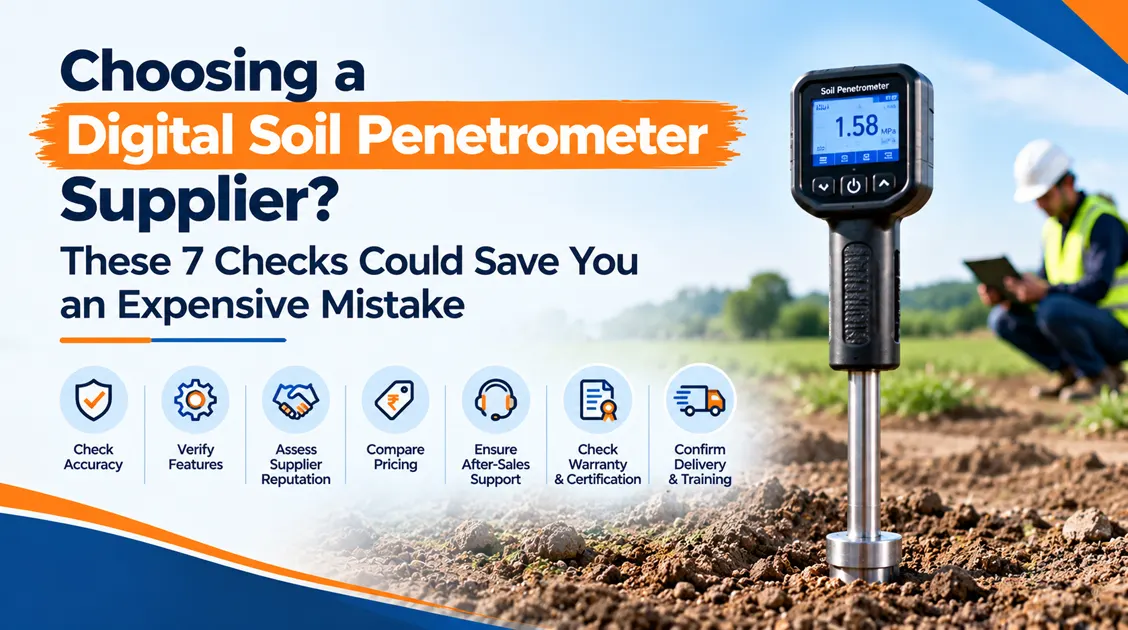
A soil testing instrument can look impressive in a catalogue. It has a digital display, a sturdy probe, and a list of technical features. But will it collect the information your team actually needs?
That question matters more than the appearance of the equipment.
Whether you are investigating soil compaction, comparing field conditions, or planning a research programme, choosing a Digital Soil Penetrometer Supplier begins with understanding the measurement—not simply comparing prices.
Different penetrometers serve different purposes. Their readings, operating methods, and suitable applications are not automatically interchangeable.
This Avantech guide explains how digital soil penetrometers work, what influences their results, and seven practical checks to make before purchasing. It also covers the questions that help turn a supplier enquiry into a useful technical discussion.
What Is a Digital Soil Penetrometer?
A digital soil penetrometer is an instrument that measures resistance as a specified probe penetrates soil and presents the measurement electronically.
Depending on the design, it may display force, penetration resistance, or resistance against depth. Certain models also provide data storage, location recording, or software connectivity.
Portable electronic cone instruments are used to investigate soil penetration resistance within their specified operating depths. However, features such as automatic depth measurement and GPS are model-specific.
The key distinction is that penetration resistance describes the soil’s response to a particular probe and procedure. It should not automatically be treated as a direct measurement of dry density, bearing capacity, or every aspect of soil strength.
What Does a Digital Soil Penetrometer Supplier Do?
A Digital Soil Penetrometer Supplier provides equipment and should help buyers identify a configuration suited to their intended application.
A useful discussion goes beyond availability and price. It addresses the instrument type, measurement range, probe geometry, depth capability, operating procedure, accessories, and documentation.
For example, a buyer studying shallow agricultural compaction has different requirements from a laboratory evaluating cohesive soil samples.
Before requesting a quotation, explain what you need to measure and how the results will be used. This allows the supplier to confirm suitability and identify limitations before the equipment reaches your site.
Why Are Digital Soil Penetrometers Used?
Investigating Soil Compaction Patterns
Portable cone penetrometers can help investigate the extent and depth of resistant soil layers.
In agricultural applications, this information can support investigation of potential compaction concerns. Results should be interpreted alongside soil conditions and field observations. Penn State Extension identifies penetrometers as diagnostic tools for examining subsurface compaction.
Comparing Locations
A planned survey can compare measurements across selected locations, such as trafficked areas and nearby reference areas.
The comparison becomes more useful when operators use consistent equipment, procedures, and recording methods.
Supporting Research
Research teams may collect penetration measurements alongside moisture, soil classification, or other observations.
The instrument should support the required repeatability, data access, and documentation rather than merely displaying a maximum reading.
Maintaining Field Records
Digital logging can simplify recording and subsequent review where the selected model supports it.
Commercial penetrologgers can store measurements and transfer them to software for numerical or graphical analysis. Confirm the exact workflow for the proposed instrument.
Understand the Different Penetrometer Types
The word “penetrometer” covers several instruments. A digital display does not make them equivalent.
Instrument category | Typical purpose | Important distinction |
Portable electronic cone penetrometer | Investigating shallow soil penetration resistance | Capabilities depend on probe, depth, and procedure |
Pocket penetrometer | Assessing cohesive soil consistency | Uses an empirical relationship for approximate strength |
Electronic CPT/CPTu system | Subsurface geotechnical investigation | Uses specialised cones, pushing equipment, and defined procedures |
Dynamic cone penetrometer | Measuring penetration under repeated hammer impacts | Operates differently from a steadily pushed probe |
ASTM describes pocket penetrometers as tools for evaluating cohesive soil consistency and approximating unconfined compressive strength. Electronic cone and dynamic cone tests have separate procedures and measurement arrangements.
Identify the correct category before comparing suppliers.
7 Checks Before Choosing a Digital Soil Penetrometer Supplier
1. Confirm the Instrument Matches Your Application
Begin with a short description of the work.
Will operators test intact ground or prepared samples? Is the investigation agricultural, laboratory-based, or geotechnical? Do you need individual readings or a resistance profile?
Share the expected soil conditions and access restrictions.
A useful proposal should explain why the suggested instrument suits that application. Avoid relying on a broad description such as “suitable for soil testing,” which leaves the most important questions unanswered.
2. Review Measurement Range, Accuracy, and Resolution
These specifications describe different characteristics.
Range identifies the instrument’s operating limits. Resolution describes the smallest displayed increment. Accuracy concerns how closely measurements meet the stated specification under defined conditions.
Ask whether accuracy is expressed relative to the reading or the full measurement range.
Also clarify what happens when the instrument reaches its limit. An over-range indication should not be mistaken for a valid measurement.
Request the technical datasheet and any conditions attached to its performance claims.
3. Check Probe Geometry and Depth Capability
Probe dimensions are part of the measurement method.
Confirm the cone geometry, shaft arrangement, available replacement tips, and intended penetration depth. Ask how depth is measured and whether resistance readings are automatically linked to it.
For repeated surveys, establish how worn or damaged components will be identified and replaced.
Do not assume that adding a longer rod preserves the instrument’s validated performance. Obtain written confirmation of approved configurations and their limitations.
4. Ask About Calibration and Routine Verification
Request an explanation of the calibration documentation supplied with the instrument.
Check whether it identifies the instrument, relevant measurement channels, calibration conditions, and results. Separately, ask what routine checks operators should perform before use.
A practical verification procedure helps teams recognise problems before collecting a full day of questionable data.
Also establish the recalibration route, expected service arrangements, and whether the instrument must be returned elsewhere for assessment.
5. Examine Data Storage and Export
Consider the report your team needs to produce.
Can the instrument retain individual measurements, depth profiles, location identifiers, and operator notes? Can users export raw data in a workable format?
If software is required, confirm compatibility, licence terms, and the transfer process.
Some commercial models offer GPS, digital logging, and optional moisture measurement. These are useful possibilities to discuss, rather than features to assume are included in every quotation.
6. Evaluate Field Usability and Training
Operators need equipment they can use consistently under actual working conditions.
Review handle arrangement, display readability, transport protection, charging, cleaning, and the manufacturer’s environmental limits.
Ask for a demonstration of the complete procedure, including setup, measurement, data storage, and troubleshooting.
Training should explain how to respond to obstructions, unstable readings, and operating limits. Knowing when to stop a measurement is as important as knowing how to begin one.
7. Compare the Complete Cost
Compare equivalent packages rather than headline prices.
A quotation should identify the instrument, probes, accessories, software, calibration documentation, training, delivery, warranty, and service terms.
Ask which items are optional and which are necessary for your intended work.
Replacement components and ongoing support can materially affect ownership costs. A clear, itemised proposal makes it easier to assess value and reduces the chance of discovering missing essentials after purchase.
What Can Affect Soil Penetrometer Readings?
Soil Moisture
Moisture conditions strongly influence interpretation.
For agricultural compaction diagnosis, Penn State guidance recommends measurements under suitable moisture conditions and explains that excessively wet or dry soil can distort the apparent compaction picture. Record moisture context when comparing surveys.
Operating Technique
Follow the instrument’s specified insertion procedure.
Keep alignment and penetration technique consistent. Where the instrument provides speed guidance, use it as intended; some commercial models include visual or audio feedback.
Local Obstructions
An unexpected increase in resistance deserves investigation.
Record suspected stones, roots, or other obstructions and follow the survey protocol for repeat measurements. Avoid assigning every isolated peak to a continuous compacted layer.
Survey Design
A convenient test point may not represent the whole area.
Plan locations, repetitions, reference areas, and recording requirements before starting. Preserve the context needed to explain differences between measurements.
Preparing an Equipment Enquiry for Avantech
A detailed brief helps Avantech respond to a Digital Soil Penetrometer Supplier enquiry with relevant equipment information.
Include your intended application, soil conditions, required depth, measurement outputs, expected testing frequency, and reporting needs.
Explain whether your team needs portable field measurements, laboratory assessment, or a specialised investigation system.
Request a written proposal identifying the recommended configuration, specifications, included accessories, documentation, training, and support terms.
A demonstration using a relevant workflow can also help your team assess whether the proposed equipment fits daily operations.
Frequently Asked Questions
Does a digital soil penetrometer measure soil density directly?
Generally, it measures penetration-related force or resistance. Do not treat that output as a direct dry-density result without a justified, application-specific relationship.
Can it determine foundation bearing capacity?
A portable reading alone is insufficient to establish design bearing capacity. The interpretation requires an appropriate geotechnical investigation and engineering assessment.
Can every digital model record depth profiles?
No. Depth measurement, logging intervals, storage, and export capabilities vary. Confirm each requirement against the proposed model.
Is digital equipment automatically more accurate?
No. Digital presentation improves readability and may simplify logging, but measurement quality still depends on the instrument, calibration, procedure, and conditions.
What should I prioritise when comparing suppliers?
Prioritise application suitability, clear specifications, documentation, usable data, training, and support. Compare price after confirming that the proposed packages meet the same needs.
Make the Measurement Requirement Your Starting Point
Choosing a Digital Soil Penetrometer Supplier is easier when you know what information the instrument must provide.
Define the application, confirm the measurement method, and evaluate the complete operating workflow. That preparation helps your team select equipment it can use and interpret consistently.