
Field Cbr Testing: 7 Mistakes That Could Mislead Your Next Road Project
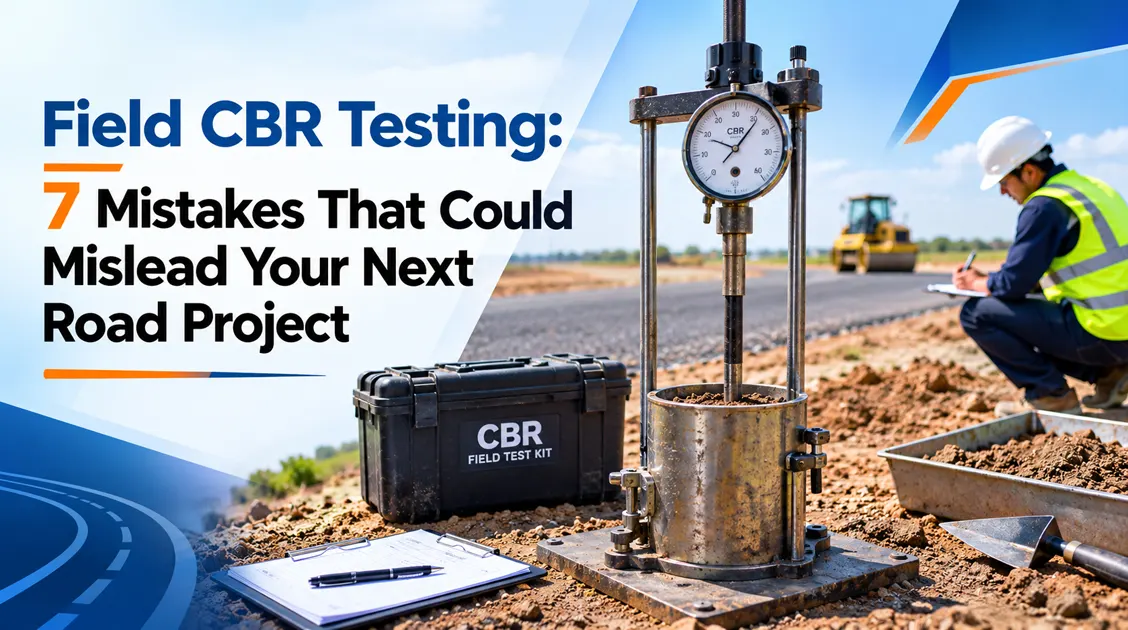
A prepared road formation can look firm, level, and ready for construction. But appearance alone does not explain how the material will resist penetration under a controlled load.
For pavement engineers and site teams, understanding the supporting ground is an important part of evaluating construction conditions. That is where Field CBR testing can contribute useful information.
Field Cbr means determining the California Bearing Ratio of material tested in place. The test measures resistance to penetration and compares it with a standard reference resistance.
However, the result represents a particular material, location, and condition. It should not be treated as a universal statement about an entire site or every future moisture condition.
What Is Field Cbr Testing?
Field CBR is an in-place penetration test used to assess the relative resistance of subgrade soils and certain pavement-layer materials.
A specified piston is pushed into the prepared test surface while the applied load and penetration are measured. The result is expressed as a percentage of the corresponding reference resistance.
ASTM D4429 describes in-place CBR testing for evaluating subgrade soils, with applicability to subbase and some base-course materials.
CBR is an empirical index. It is not itself a direct measurement of allowable foundation bearing pressure, soil density, or elastic modulus.
Its engineering use depends on the governing specification and interpretation framework.
How Is Field CBR Different from Laboratory CBR?
The main distinction is the condition and location of the material tested.
Consideration | Field CBR | Laboratory CBR |
Test location | Material tested in place | Specimen tested in a laboratory mould |
Material condition | Existing condition at the test point | Prepared and conditioned as specified |
Reaction arrangement | Field reaction system | Laboratory loading frame |
Moisture context | Site condition requires documentation | Conditioning follows the selected procedure |
Interpretation | Relates to the tested field condition | Relates to the prepared specimen condition |
ASTM distinguishes laboratory-compacted CBR testing under D1883 from in-place testing under D4429.
Results should not be assumed equivalent merely because both are reported as CBR percentages.
What Equipment Is Needed?
Loading Jack and Penetration Piston
The loading mechanism applies force through the specified piston.
The equipment must provide suitable capacity, alignment, travel, and control for the required procedure.
Load Measurement Device
A calibrated proving ring or suitable load-measurement system records the applied force.
Its working range and calibration relationship must suit the expected loads.
Penetration Measurement System
A dial gauge or displacement sensor records penetration relative to a stable reference arrangement.
Reaction Arrangement
The jack requires an adequate opposing reaction.
Commercial field sets commonly use a suitable heavy vehicle or equipment as the reaction source. Its adequacy and attachment arrangement must be established for the test.
Surcharge and Accessories
Appropriate surcharge weights, extensions, connectors, and supports complete the setup.
Confirm the full equipment list against the selected method.
How Is Field CBR Testing Carried Out?
1. Select and Identify the Location
Choose locations according to the investigation plan.
Record coordinates or chainage, test elevation, layer description, and relevant site observations.
2. Prepare the Surface
Expose and prepare the test surface according to the procedure.
Avoid unnecessary disturbance that changes the condition the investigation is intended to assess.
3. Assemble the Equipment
Align the piston and load train, establish the reaction, position surcharge as required, and install the penetration reference.
Check that the reference supports will remain stable during loading.
4. Apply Load and Record Penetration
Follow the specified penetration procedure and measurement intervals.
Record enough information to construct and review the load–penetration relationship.
5. Calculate and Review the Result
Apply the method’s calculation and correction requirements.
Check the curve, instrument records, and observations before accepting the reported percentage.
Discussing Your Requirements with Avantech
For a Field Cbr equipment enquiry, provide Avantech with the governing specification, expected materials, test locations, available reaction equipment, and reporting requirements.
Avantech field equipment listings include a CBR Field Test Set and a separately listed CBR dyn product. Confirm their respective operating principles and intended outputs before selecting equipment.
Request an itemised proposal identifying included accessories, calibration documentation, training, and support.
Make clear whether you require direct in-place CBR testing or another measurement used to estimate CBR.
Frequently Asked Questions
What does Field Cbr stand for?
It refers to the California Bearing Ratio determined for material tested in place.
Is Field CBR the same as soil bearing capacity?
No. It is a penetration-resistance index. Foundation bearing capacity requires an appropriate engineering assessment.
Does it replace compaction testing?
Not automatically. CBR and field density measurements answer different questions. Follow the project’s specified testing requirements.
Can a DCP provide CBR?
A DCP can support a CBR estimate through an appropriate correlation. Reports should distinguish that estimate from direct testing.
What is a good Field CBR value?
There is no universal acceptance value. Requirements depend on the pavement application, material, design framework, and project specification.
Make Every Field Result Traceable
Useful Field CBR testing combines a suitable setup, representative locations, controlled measurements, and clear reporting.
Define the investigation purpose and tested condition before interpreting the percentage.