
Rock Triaxial Testing Equipment: 7 Checks That Could Save Your Lab an Expensive Mistake
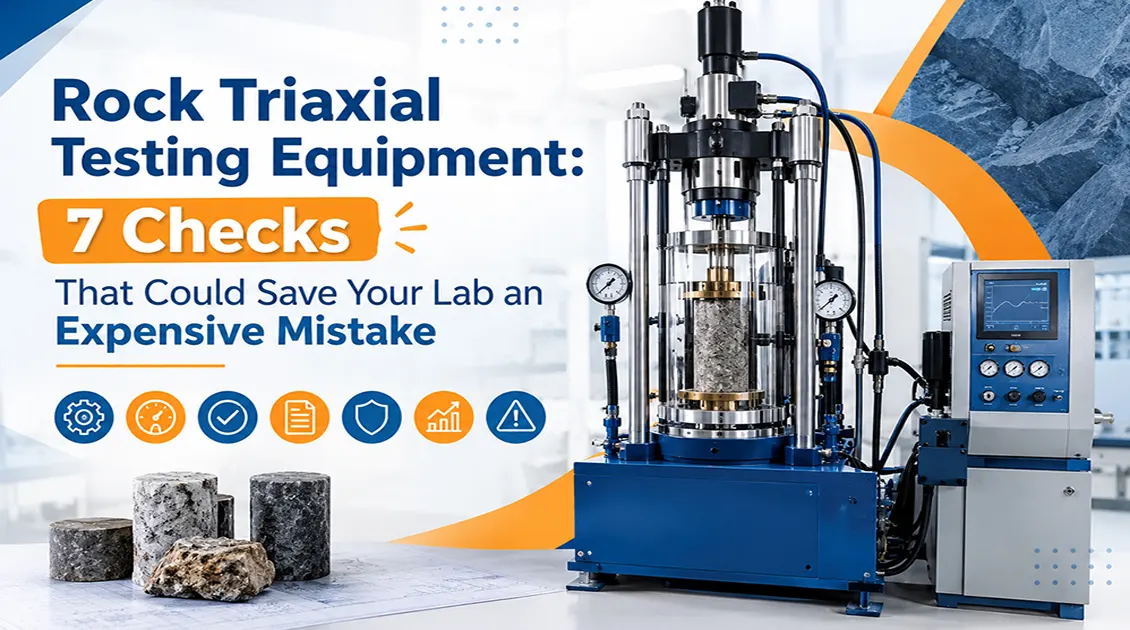
A rock core can withstand a substantial load in one test and behave differently when pressure acts around it. For laboratories investigating rock strength, that difference is central to understanding the material.
Yet choosing a testing system often begins with a simpler question: how much load can the machine apply?
Load capacity matters, but it tells only part of the story. Confining pressure, specimen preparation, strain measurement, control capability, and reporting all influence whether the equipment can deliver useful results.
Rock Triaxial Testing Equipment evaluates rock specimens under controlled axial loading and surrounding pressure. It allows laboratories to investigate strength and deformation under specified confinement conditions.
This Avantech guide explains how the equipment works, where it is used, and seven checks to make before selecting a system for your laboratory.
What Is Rock Triaxial Testing Equipment?
Rock Triaxial Testing Equipment is a laboratory system that applies axial compression to a rock specimen while maintaining controlled pressure around it.
A typical conventional system includes a loading frame, pressure cell, confining-pressure controller, measurement instruments, and data acquisition equipment.
The specimen is usually a prepared cylindrical rock core. Its response is recorded as loading progresses.
With suitable instrumentation and procedures, the system can investigate compressive strength and deformation characteristics. The required configuration depends on whether the laboratory needs strength measurements alone or additional information about strain and elastic behaviour.
It is therefore better to think of the equipment as an integrated testing system rather than a compression machine with one extra accessory.
Why Does Confining Pressure Matter?
Rock underground experiences stresses from more than one direction. A laboratory test without lateral confinement represents a different condition from a test conducted under surrounding pressure.
ASTM explains that rock strength and deformation depend on confining pressure and identifies triaxial compression testing as a method used to investigate stress conditions relevant to underground rock.
Consider a laboratory comparing specimens at several confining pressures. The objective is to understand how the measured response changes across those conditions.
This provides more information than a single unconfined strength result. However, the selected pressures and loading programme must reflect the investigation objective.
How Does Rock Triaxial Testing Work?
1. Prepare and Document the Rock Core
The process begins with specimen selection and preparation.
Record the rock description, specimen dimensions, orientation, moisture condition, and visible features. Prepare the cylindrical surface and bearing ends to the requirements of the chosen method.
ASTM D4543 addresses preparation and dimensional checks for cylindrical rock specimens used in strength and deformation testing.
2. Assemble the Specimen in the Cell
Fit the specimen into the appropriate sleeve or membrane arrangement and position it between the loading components.
A Hoek cell is one established cell type used for rock triaxial testing. Its components and compatible specimen dimensions must suit the proposed programme.
3. Establish Confinement and Apply Loading
Apply the required confining pressure, check the system, and begin axial loading under the specified control procedure.
Record load, pressure, and the deformation channels required for the test.
4. Review the Results
Assess the measurements alongside specimen records and observations. Report the loading conditions, relevant calculations, failure characteristics, and any departures from the procedure.
What Can the Test Tell You?
Depending on the apparatus and method, testing can provide information about:
- Compressive strength under selected confining pressures.
- Relationships between stress and strain.
- Elastic properties where suitable strain measurements are available.
- Changes in response across a series of pressure conditions.
ASTM D7012 includes methods addressing intact rock strength and elastic properties under uniaxial and triaxial loading. Its conventional triaxial methods have defined scope and stress conditions; laboratories should confirm that these match the intended investigation.
A strength-only setup should not automatically be presented as capable of every deformation, drainage, or advanced research measurement.
Where Is Rock Triaxial Testing Equipment Used?
Underground Construction Investigations
Laboratory rock properties can contribute to investigations for tunnels, caverns, shafts, and other underground works.
The testing programme should connect the requested measurements to the engineering questions being examined.
Mining Studies
Mining investigations may require comparisons between rock types, specimen orientations, or confinement conditions.
Clear sampling records help reviewers understand what each laboratory result represents.
Infrastructure and Foundation Studies
Rock testing may form part of a wider investigation for foundations, slopes, or excavations.
The laboratory results need to be considered alongside geological observations and site information.
Academic and Specialist Research
Research programmes may require controlled loading paths, temperature functions, pore-pressure measurements, or additional sensors.
These are configuration-specific requirements. Define them before selecting the apparatus.
7 Checks Before Choosing Rock Triaxial Testing Equipment
1. Define the Required Test Outputs
Begin with the information your laboratory must deliver.
Do you need peak strength, axial strain, lateral strain, elastic properties, or response beyond peak load? Will the programme involve several confinement levels?
Write these requirements into a short technical brief.
This prevents an apparently suitable system from arriving without the sensors, accessories, or control functions needed for the actual work.
2. Match Load Capacity to the Specimens
Select capacity using the proposed specimen dimensions and anticipated rock behaviour.
Also examine the load measurement range, stated accuracy, and performance at the loads you expect to use.
A high maximum capacity does not explain how effectively the instrument measures smaller loads.
Ask the supplier to identify the suitable operating range and explain the basis for the proposed load cell and frame selection.
3. Confirm the Complete Pressure Rating
Review the cell, controller, tubing, connectors, seals, and other pressure-bearing components as one assembly.
Confirm the permitted operating conditions for the complete proposed configuration.
Manufacturers offer high-pressure cells with different specifications and options, illustrating why pressure capability must be checked against the particular model rather than assumed from the equipment category.
Include replacement sleeves and seals in the discussion.
4. Check Specimen and Cell Compatibility
List every specimen diameter and preparation arrangement the laboratory expects to use.
Confirm compatible cells, loading platens, sleeves, spacers, and strain instruments.
Also check the space available inside the frame with the complete cell assembly installed.
A proposal should identify which components are included for each specimen size and which require separate purchase.
5. Review Loading Control and System Stiffness
Explain the loading programme in practical terms.
Routine strength testing and detailed investigation of brittle failure can place different demands on a machine.
Research on rock testing highlights the importance of machine stiffness and feedback control when studying failure behaviour. Do not assume that a system capable of recording peak load can also control a complete post-peak response.
Request evidence relevant to the intended material and measurement objective.
6. Specify Strain Measurement Properly
If deformation properties are required, identify the necessary axial and lateral measurements.
Ask where displacement or strain is measured, what gauge arrangement is used, and how instrument compatibility is maintained inside the cell.
Machine movement can include deformation in components beyond the specimen. The measurement method must therefore suit the property being calculated.
Request a demonstration of the calculation and the underlying recorded channels.
7. Evaluate Documentation and Ongoing Support
Review calibration documentation, operating instructions, software access, training, commissioning, and service arrangements.
Ask whether raw data can be exported and whether reports retain the information needed for independent review.
Confirm the availability of replacement consumables and compatible accessories.
These details affect how consistently the laboratory can operate the system after installation, especially when staff or testing requirements change.
Rock Triaxial Testing vs Uniaxial Compression Testing
Consideration | Uniaxial compression testing | Conventional triaxial compression testing |
Loading condition | Axial compression without applied lateral confinement | Axial compression with controlled confinement |
Pressure cell | Generally unnecessary | Required |
Pressure control | Not required for lateral confinement | Required |
Investigation focus | Unconfined response | Response under selected confinement |
Instrumentation | Depends on required outputs | Depends on outputs and cell compatibility |
Both approaches can be useful. Choose the method according to the information required rather than treating one result as a substitute for the other.
Common Mistakes That Weaken a Testing Programme
Overlooking Specimen Preparation
Equipment cannot compensate for poorly prepared specimens.
Document preparation checks and retain enough information to explain rejected specimens or unusual results.
Comparing Different Conditions Without Context
Moisture condition, orientation, specimen features, loading procedure, and confinement should remain visible in the records.
A comparison is difficult to assess when these details are missing.
Treating Intact Rock Results as Rock Mass Properties
Laboratory cores represent limited volumes of material.
Joints, faults, weakness planes, and other large-scale features affect field behaviour. ASTM cautions that intact specimen properties require engineering judgment when applied to rock masses.
Assuming Software Validates the Test
Automatic calculations still depend on correct inputs and valid measurements.
Review specimen dimensions, units, channel setup, and calculation settings before accepting the report.
Planning an Equipment Enquiry with Avantech
A clear brief helps make discussions about Rock Triaxial Testing Equipment more productive.
Provide Avantech with the rock types, specimen dimensions, anticipated loads, confining-pressure requirements, selected methods, and required measurements.
Include laboratory access, utilities, expected testing volume, and reporting needs.
Request a written configuration identifying included equipment, optional functions, installation requirements, training, and support terms. Where advanced testing is required, ask for confirmation against the specific procedure.
Frequently Asked Questions
What is Rock Triaxial Testing Equipment used for?
It investigates rock strength and deformation under controlled axial loading and confining pressure.
Is every rock triaxial system a true triaxial system?
No. Conventional axisymmetric testing uses equal lateral principal stresses. True triaxial equipment allows the three principal stresses to be controlled independently.
Can one system perform uniaxial and triaxial tests?
Some systems support both with suitable accessories and configurations. Confirm the complete equipment requirements.
Does testing measure elastic properties automatically?
Only when the required instrumentation, procedure, and calculations are available and appropriate.
What should a laboratory prioritise before purchasing?
Prioritise method suitability, specimen compatibility, load and pressure performance, measurement capability, documentation, and support.
Build the Equipment Specification Around the Test
Useful rock testing begins with a clear question and a system configured to answer it.
Define the specimens, loading conditions, required measurements, and reporting expectations before comparing proposals.